FEDERATION
CYNOLOGIQUE INTERNATIONALE (AISBL)
SECRETARIAT
GENERAL: 13, Place Albert 1er B – 6530 Thuin (Belgique)
______________________________________________________________________________
30.03.2009/EN
FCI-Standard
N° 94
PORTUGUESE
WARREN HOUND –
PORTUGUESE
PODENGO
(Podengo
Português)
TRANSLATION
: Portuguese Kennel Club. Revised by Jennifer
Mulholland
and Renée Sporre-Willes
ORIGIN
: Portugal.
DATE
OF PUBLICATION OF THE OFFICIAL VALID
STANDARD
: 04.11.2008.
UTILIZATION
: Hunting dog, watch dog and companion dog
FCI-CLASSIFICATION
: Group 5 Spitz and Primitive types.
Section
7 Primitive type – Hunting Dogs. Without working trial.
BRIEF
HISTORICAL SUMMARY : Primitive type dog, it
probably
originates from the ancient dogs brought by the
Phoenicians
and Romans to the Iberian Peninsula in the Classic
Antiquity.
It was subsequently influenced by the introduction of
dogs
accompanying the Moors in their invasions in the 8th century. It
adapted
to the Portuguese terrain and climate, to become what is
nowadays
known as the Portuguese Warren Hound. It evolved
morphologically
throughout the centuries due to its functionality,
with
the small variety being selected, from the 15th century on, as a
ratter
on the Caravels of the Portuguese navigators.
GENERAL
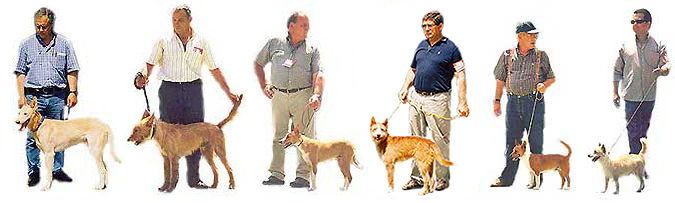
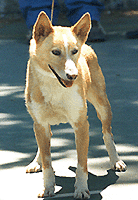
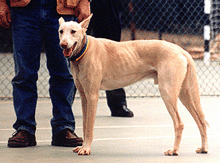
APPEARANCE : Quadrangular pyramidal head, with
erect
ears, sickle shaped tail, well proportioned, with sound
construction
and well muscled; very lively and intelligent; sober and
rustic.
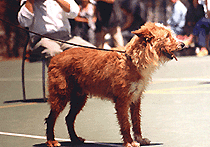
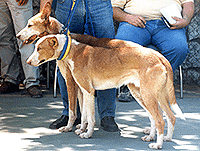
It exists in three sizes, with two varieties of coat: smooth and
wire.
IMPORTANT
PROPORTIONS :
Large
and Medium-sized Podengo : Almost square (Submediolinear) of large or medium
substance respectively.
Ratio
of length of body to height at the withers: 11/10 and depth of
chest
to height at withers: 1/2.
Small
Podengo : Body slightly longer than high (Sub-longilinear), of
small
stature. The length of the body is slightly more than the height
at
withers with a ratio – length of body/height at the withers: 6/5 and
depth
of chest /height at withers: 1/2.
In
all varieties, the muzzle length is less than the skull length.
BEHAVIOUR
/ TEMPERAMENT :
Large
Podengo : used for hunting big game.
Medium
Podengo : also known as Warren Hound, its natural
aptitude
as a rabbit hunter is well used, hunting either in a pack or
alone.
Small
Podengo : used for searching rabbits in holes and rocks.
All
varieties are also used as watch dogs and as companion dogs.
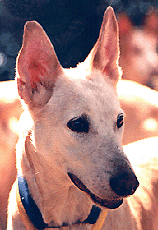
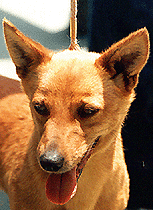
HEAD
: Lean and of a quadrangular pyramid shape, with large base
and
definite pointed muzzle. The longitudinal superior craniumfacial axes are
divergent.
CRANIAL
REGION :
Skull
: Flat; almost straight in profile; prominent superciliary arches;
scarcely
perceptible frontal furrow; the area between the ears is
horizontal
with prominent occipital protuberance.
Stop
: Barely defined.
FACIAL
REGION :
Nose
: Tapered and obliquely truncated, prominent at the tip; of
darker
colour than the coat.
Muzzle
: Pointed; curved seen from the front, with a straight profile;
shorter
than the skull; broader at the base than at the tip.
Lips
: Close fitting, thin; firm, horizontally cut and well pigmented.
Jaws/Teeth
: Normal with scissors bite, with solid, white teeth;
normal
occlusion of both jaws. Full dentition in the large variety.
Cheeks
: Lean and obliquely set, seen from the front.
Eyes:
Very lively expression; not prominent; they are small and
slanted
with the colour ranging from honey to brown, in accordance
with
the coat; lids darker than the coat colour.
Ears
: Set on obliquely at the level of the eyes; straight, erect, with
high
mobility; vertical or tilting slightly forward, when attentive;
pointed,
wider at the base, triangular; thin, of considerable length,
more
than the width at the base.
NECK
: In a harmonious transition from head to body; straight;
long;
well proportioned, strong and well muscled; without dewlap.
BODY
:Top line: Straight, level.
Withers
: Only slightly visible in relation to the neck and back.
Back
: Straight and long.
Loin
: Straight; broad and well muscled.
Croup
: Straight or slightly sloping; medium sized; broad and well
muscled.
Chest
: Down to the elbows; of moderate width; long, with the
sternum
rising back and up; ribs slightly sprung and inclined;
forechest
neither too apparent nor too muscled and of moderate
width.
Underline
and belly : Slightly tucked up; lean belly and flanks.
TAIL
: Natural, set on rather higher than low; strong, thick and
thinning
to the tip, of medium length; at rest falls slightly curved
between
the buttocks down to the hocks, in action it rises
horizontally
either slightly curved or vertically in sickle shape, but
never
curled; fringed on the under side.
LIMBS
FOREQUARTERS
:
General
appearance : Upright when seen from front and sides; well
muscled
and lean.
Shoulder
: Long; inclined; strong and well muscled; scapulahumerus angle, approximately
110º.
Elbow
: Parallel to the main line of the body.
Forearm
: Vertical; long and well muscled.
Carpus
(Pastern joint) : Lean and not prominent.
Metacarpus
(Pastern) : Short; strong; slightly inclined.
Forefeet
: Rounded; long toes, strong, tight and arched; with strong
and
preferably dark nails, tough and firm pads.
HINDQUARTERS
:
General
appearance : Upright when seen from back and sides; well
muscled
and lean; parallel to the main body line.
Thigh
: Long; of medium width; well muscled.
Stifle
joint : Femur-tibia angle approximately 135º.
Second
thigh : Inclined; long; lean, strong, well muscled.
Hock
: Of medium height; lean; strong; open hock angle,
approximately
135º.
Metatarsus
(Rear Pastern) : Strong; short; inclined; without
dewclaws.
Hind
feet : Rounded; long toes, strong, tight and arched; short and
strong
nails, preferably dark; tough and firm pads.
GAIT/MOVEMENT
: Light trot, easy and agile movement.
SKIN
: Thin and tight. Mucous membranes preferably dark
pigmented
or always darker than the coat.
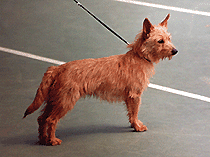
COAT
Hair
: Two varieties: Either short and smooth or long and wire -
both
of medium thickness; without undercoat. The short coat is more
dense
than the wire coat. In the wire variety the hair on the muzzle is
longer
(bearded).
Colour
: Yellow and fawn in all shades from light to dark, with or
without
white markings, or white with patches of these colours.
In
the Small Podengo, the following colours are accepted but not
preferred:
black, brown, with or without white markings, or white
with
patches of these colours.
HEIGHT
AND WEIGHT:
Height
Small:
20 to 30 cm
Medium:
40 to 54 cm
Large:
55 to 70 cm
Weight:
Small:
4 to 6 Kg
Medium:
16 to 20 Kg
Large:
20 to 30 Kg
FAULTS:
Any departure from the foregoing points should be
considered
a fault and the seriousness with which the fault should be
regarded
should be in exact proportion to its degree and its effects on
the
health and welfare of the dog.
•
Behaviour : Signs of shyness.
•
Cranium/Muzzle : Parallel longitudinal superior craniumfacial axes.
•
Jaws : Incorrect occlusion or badly implanted teeth; pincer
bite;
incomplete dentition in the large variety.
•
Nose : Partial lack of pigmentation.
•
Neck : Arched.
•
Body : Arched top line.
•
Croup : Too sloping.
•
Dewclaws : Their existence is not appreciated.
•
Coat : Silky and/or with undercoat.
SEVERE
FAULTS :
•
Cranium/Muzzle : Convergent superior cranium-facial axes.
•
Nose : Total lack of pigmentation.
•
Ears : Rounded.
•
Belly : Too tucked up.
•
Tail : Curled.
DISQUALIFYING
FAULTS :
•
Aggressive or overly shy dogs.
•
Any dog clearly showing physical or behavioural
abnormalities
shall be disqualified.
•
General Appearance : Signs of crossbreeding to sighthounds,
pointing
breeds or any other crossbreeding.
•
Jaws : Undershot or overshot.
•
Eyes : Of different colours.
•
Ears : Folded or hanging.
•
Colour : Brindle; black and tan; tricolour and totally white.
N.B.:
•
Male animals should have two apparently normal testicles
fully
descended into the scrotum.
•
Only functionally and clinically healthy dogs, with breed
typical
conformation should be used for breeding.
|